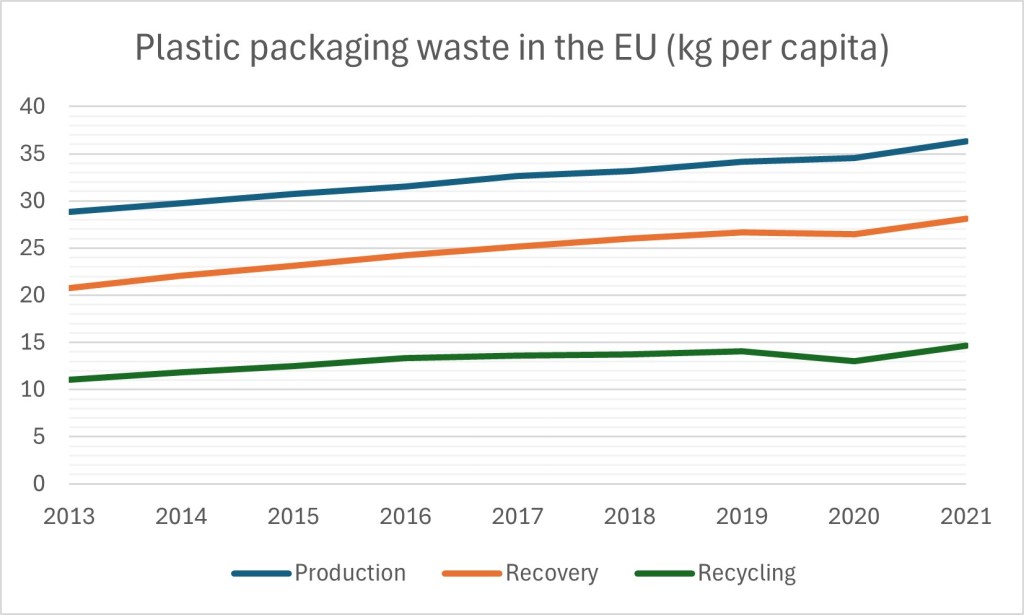
The total plastic packaging waste produced in the EU in 2021 was 16,13 million tons. It is equivalent to 36.1 kilos per capita et per year (29% increase between 2010 and 2021). In 2021, 6,56 million tons of plastic waste were recycled in the EU. Even if the recycling capacity in the EU has increased, it is not enough to compensate the increase of packaging plastic wastes as illustated by the chart below.
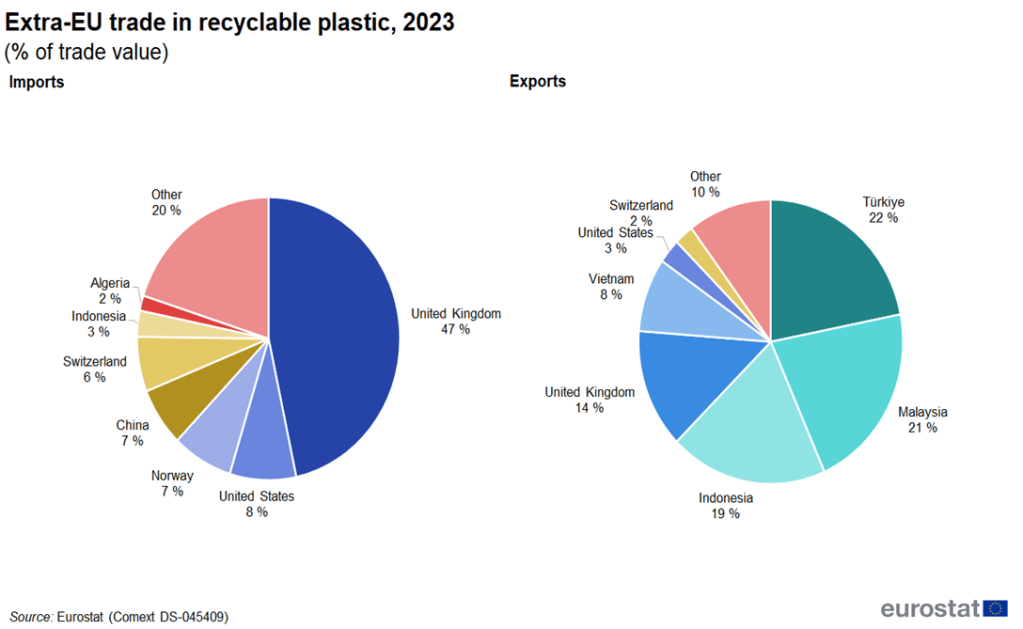
For many years, high-income countries exported large quantities of plastic waste to lower-income countries. In 2018, however, China banned the import of most plastic waste. As a result, the global plastic waste trade shifted to other countries, primarily in Southeast Asia. The export of plastic waste to countries with less stringent environmental regulations has led to significant environmental degradation and health issues.
In order to enhance the control of the transboundary movements of plastic waste, the Basel Convention added three new entries specific to plastic waste (it did not exist before) in the annexes:
- A3210: plastic wastes presumed to be hazardous
- B3011: plastic wastes that are presumed to not be hazardous, provided the waste is destined for recycling in an environmentally sound manner and almost free from contamination and other types of wastes;
- Y48: including mixtures of plastic waste unless these are hazardous
As of 1 January 2021, all plastic wastes with the exception of waste covered by entry B3011 will be subject to the “prior informed consent” PIC procedure. At the same time the Basel Convention established the Plastic Waste Partnership (see terms of reference) to mobilize business, government, academic and civil society resources, interests and expertise to improve and promote the environmentally sound management (ESM) of plastic waste. This partnership supports 23 pilot projects (see details).
As it concerns the EU, the new EU waste shipment Regulation (EU) 2024/1157 entered on 20 May 2024 in force. In line with the EU Green Deal and the updated Circular Economy, it is aimed at 1) Ensuring sound management of the waste generated in the EU; 2) Preventing illegal shipment of waste through better enforcement; 3) Increasing traceability of waste shipment. Any recovery installation outside the EU must also be audited by a third independent party on the basis of the criteria set in Annex X in accordance with the ISO standard 19011/2018 or 17020/2012. The new regulation makes a distinction between OECD and non-OECD countries
- non OECD countries: The intention is to introduce a general ban on the export of waste of any kind. An exception can be granted by the European Commission if the country demonstrates its ability to treat the waste in an environmentally sound manner. A first list will be published in November 2026, while the ban will come into force in May 2027. As it specifically concerns plastic waste, the two deadlines has been set 6 months earlier and shipment will fall under the PIC procedure in all cases.
- OECD countries: The procedures are similar as to the regime for shipment between Member States but with additional monitoring requirements. As it concerns specifically the plastic waste plastic, the European Commission will actively assess until May 2026 the compliance of OCDE countries importing significant volume of waste from the EU. At that time, the PIC procedure for B3011 waste will then become mandatory.
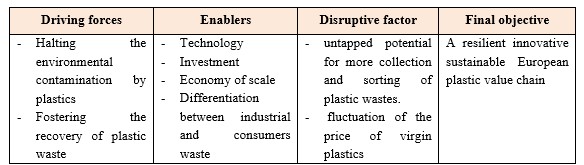
In order to boost the EU plastic waste recycling capacity recycling capacity, the EU launched in December 2018 the Circular Plastic alliance (link) to mobilise action from all players in the plastic value chain. The alliance has endorsed the target set by the 2018 European strategy for plastics that by 2025 at least 10 million tonnes of recycled plastics should find their way into products and packaging in Europe each year. To meet this target, the Declaration recognised the need to update or revise European standardization deliverables, especially considering that plastics recycling is often taken care of by regional SMEs and public facilities which need cost-effective solutions to manage their operations and ensure consistency of their outputs. The European Commission has mandated CEN and CENELEC to revise 11 European Standards, as well as to develop around 45 new deliverables on quality grades for sorted plastic waste, characterisation of recyclates, and design-for-recycling guidelines for a wide range of products used in different applications (see details).
On December 17, 2024, an alliance of EU lobbies from the plastics, packaging, consumer goods and recycling industries released a joint statement (link) to urge the European Commission to address the existing market uncertainties to prevent further de-industrialization and establish a Single Market for waste and recycled plastics. To achieve this, best practices should be implemented across all Member States, from production and processing to collection, sorting and recycling and these should be accompanied by clear enforcement measures to ensure the progress towards legislative targets. Additionally, establishing an EU-level incentive scheme to boost further investment, as well as clear legislative measures to encourage circular solutions, will provide the plastic value chain with the financial stability to drive further innovations for the industry and continue contributing to climate change mitigation.
According to the data released by the Plastic Recyclers Europe (link), decreasing demand levels for recyclates, high production costs, and the increasing flow of imports have severely impacted the EU plastics recycling industry in 2023. For the first time, the estimated turnover decreased by 12.5% compared to 2022, reaching an estimated 9.1 billion euros. At that time, around 850 companies have been actively recycling plastics in EU27+3. In 2023, many recycling facilities closed due to difficult market conditions: decreasing demand, high electricity costs and lack of competitiveness with virgin material and imported material from outside the EU.

Meanwhile, the new Packaging and Packaging Waste Regulation will enter into force on February 11, 2025 and will apply from August 12, 2025 (see the webinar organized by DG ENV to prepare for the implementation of and smooth transition to the new rules -link). It is aimed at making all packaging on the EU market recyclable in an economically viable way by 2030 and to increase the safe use of recycled plastics in packaging. One should note that the fact that it is a regulation instead of directive means a uniform implementation across the Member States.
As outlined by the Pew Charitable Trust and Systemiq in 2020 (link), many plastic products are designed for a global market, with marketing and sales rather than end-of-life sustainability as the primary driver of product design. Globalized consumer goods supply chains do not take into account the realities of local waste management infrastructure, which can vary widely from one community to the next. Fast innovation cycles in product design outpace slow innovation downstream (waste infrastructure), exacerbating the problem.

 Sustainable Synergies