The role of utilities in fostering urban circularity

The environmental impact of cities

Today, 55% of the world’s population lives in urban areas, a proportion that is expected to increase to 68% by 2050. Projections show that urbanization – the gradual shift in residence of the human population from rural to urban areas, combined with the overall growth of the world’s population – could add another 2.5 billion people to urban areas by 2050, with close to 90% of this increase taking place in Asia and Africa.

Continue reading “The role of utilities in fostering urban circularity”

Making  investment in water infrastructure bankable

Water forms the foundation of all natural systems. Its unique physical properties make it irreplaceable for energy transfer and ecosystem regulation—earning it the designation as “the bloodstream of the biosphere.” Beyond its ecological role, water is essential for human health and economic prosperity.

To secure reliable access to this vital resource, humanity has developed infrastructure with three core functions: storage, transport, and treatment. Water infrastructure is characteristically capital-intensive and long-lived, with high upfront costs that cannot be easily recovered if projects fail. In Europe, the Water Framework Directive 2000/60/EC makes a distinction between services and uses.

Continue reading “Making  investment in water infrastructure bankable”

Water resilience: need for a new management paradigm?

In the political guidelines for the next European Commission 2024-25 released on 18 July 2024 (link), Mrs. Von der Leyen emphasized the importance of water. She stated that the upcoming European Climate Adaptation Plan must support a Water Resilience Strategy to ensure pollution sources are properly managed and scarcity is addressed. This strategy aims to enhance the competitive innovative edge of its water industry and adopt a circular economy approach. As part of this, Europe will lead efforts to mitigate and prevent acute water stress globally.

Continue reading “Water resilience: need for a new management paradigm?”

Can shipment restrictions boost EU plastic waste recycling capacity?

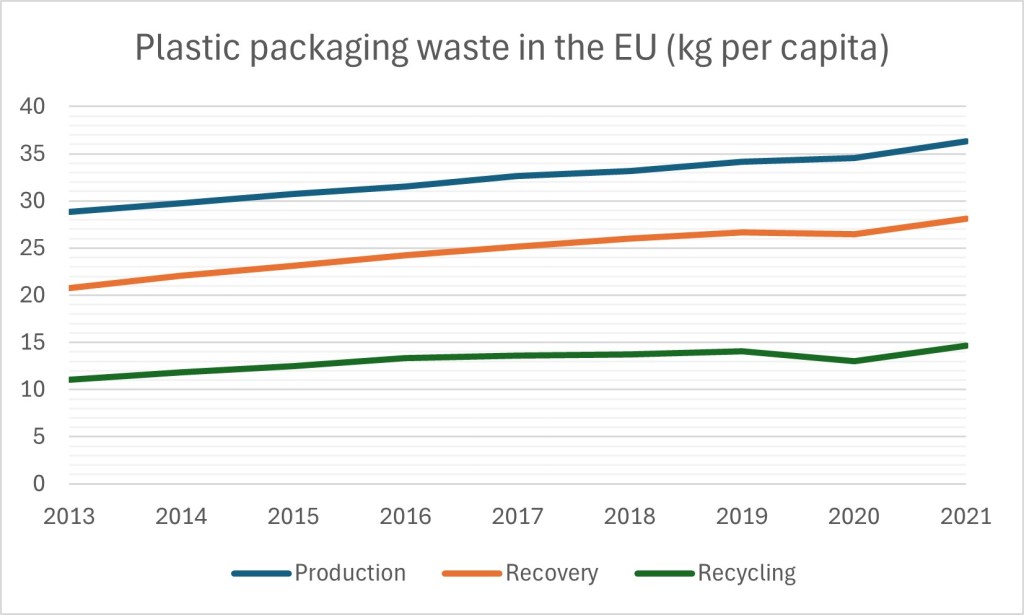
The total plastic packaging waste produced in the EU in 2021 was 16,13 million tons. It is equivalent to 36.1 kilos per capita et per  year  (29% increase between 2010 and 2021). In 2021, 6,56 million tons of plastic waste were recycled in the EU. Even if the recycling capacity in the EU has increased, it is not enough to compensate the increase of packaging plastic wastes as illustated by the chart below.

Continue reading “Can shipment restrictions boost EU plastic waste recycling capacity?”

Wind Turbine Blade Recycling: A Driving Force to Circularize the Composites Value Chain?

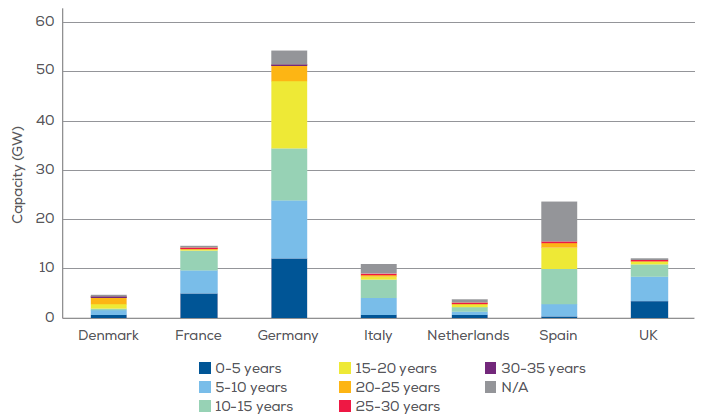
Today, the first generation of wind turbines is nearing the end of its operational life. This is a major challenge for the wind industry. On the one hand, the repowering of existing wind farms (often in the best locations) is becoming a major issue. According to Wind Europe (link), it can double the generating capacity (in MW) of a wind farm and triple the electricity output because the new turbines produce more power per unit of capacity. This is achieved by reducing the number of turbines by an average of 27%. However, operators have faced significant difficulties and delays in renewing their permits. Less than 10% of the wind turbines that will reach the end of their life in 2023 will be repowered. Many have just received a permit extension. On the other hand, the wind industry claims to be 100% circular. If composites can achieve an optimal balance of high strength-to-weight ratio, mechanical properties, design flexibility and durability, recycling these materials is a challenge whose magnitude is only beginning to be understood. According to Wind Europe, the total amount of decommissioned blade material in Europe will increase from less than 100,000 tons in 2020 to 350,000 tons in 2030. The chart below (source: Wind Europe paper) shows the age of Europe’s onshore wind fleet

Age of Europe's onshore wind fleet (source: Wind Europe)

Continue reading “Wind Turbine Blade Recycling: A Driving Force to Circularize the Composites Value Chain?”

Territorializing circularity as a key success factor for engaging the transition

The territorial dimension in CE debates receives little attention compared to the technological and economic discussion on the topic. One explanation could be that the concept of circular economy comes from the fields of industrial ecology, business and product design, which include the study of “people”, such as management and business models for circular enterprises, and “flows”, such as secondary materials and reuse methods for circular production.

Another explanation could be related to the difficulty of defining a territory. While “local” refers to a specific geographic scale, “territory” encompasses a physically delimited and socially organized space. Territories are not simply physical spaces, but are shaped by specific organizational structures and are the result of social constructs. They represent the collective effort of a group of actors working towards a common project, with its own rules of governance and cultural heritage. They may not conform to administrative boundaries.

Continue reading “Territorializing circularity as a key success factor for engaging the transition”

What ‘s next on the EU water policy agenda

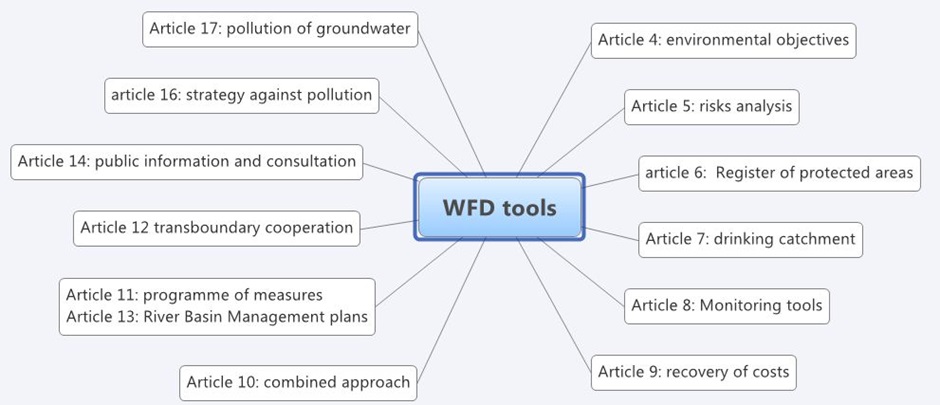
The Water Framework Directive 2000/60/EC (link) was adopted in 2000 after a12-yearof negotiation. The ambition was to restore the good ecological quality by 2015. Compared to previous EU Directives which deal with punctual issues (drinking water, bathing water, hazardous substances, etc. ) or specific pollution (urban waste water, nitrates), the WFD was clearly a big change since it provided an integrated water management approach at river basin level. This was coupled with other advanced features such as

  • Objective driven legislation
  • Ecological quality as a mean of integration
  • Adaptive planning capacity (6 year cycle)
  • Economic instruments to support decision-making and to influence polluters’ behavior
  • Transboundary cooperation (60% of the EU surface area lies in river basins that cross at least one national border)
Decription of the management tools enshrined in the Water Framework Directive 2000/60/EC
Continue reading “What ‘s next on the EU water policy agenda”

Issues currently at stake with the adoption of UN treaty on plastic pollution

In March 2022, the United Nations Environment Assembly adopted a resolution for the development of an “international legally binding instrument on plastic pollution, including in the marine environment“. The resolution calls for attention to product design, environmentally sound waste management, efficient use of resources and circular economy approaches. According to its mandate, this process is expected to deliver a proposal for a global treaty at the fifth Intergovernmental Negotiating Committing (INC-5) in Busan, Republic of Korea, from 25 November to 1 December 2024.
INC-4 took place in Ottawa from 23 to 29 April with 2,500 delegates participating in 5 working groups. As Systemiq put it in a briefing note for negotiators (link), the discussions can be grouped around 2 key variables: the scope of the treaty and the need for coordination.

Continue reading “Issues currently at stake with the adoption of UN treaty on plastic pollution”

Textile waste in Europe: a test case for the transition to Circular Economy?

According to the European Environmental Agency (link), textiles have on average the fourth highest negative life cycle impact on the environment and climate change, after food, housing and mobility, The yearly quantity of textile wastes generated in the EU amounts to approximately 7 million tons. The graph below (source EEA) present the estimated annual consumption (production + import – export) of of clothing, footwear and household textiles per inhabitant in the EU.

Continue reading “Textile waste in Europe: a test case for the transition to Circular Economy?”

Blockchain: a tool to support circular economy processes ?

The digital transformation of society and economy is seen by a large majority of waste stakeholders as a pivotal mean to “spur innovation and productivity growth, to transform waste services, and to improve the amenity of cities as information, knowledge and data become more widely available”(see the EEA 2020 report on Digital Waste Management). Despite that the waste management sector is still in an early phase in this development, digital technologies already appear as indispensable to engage the transition to Circular economy which requires a much more efficient management system since the distinction between raw materials, products and waste becomes increasingly unclear,

Continue reading “Blockchain: a tool to support circular economy processes ?”