
Making  investment in water infrastructure bankable

Water forms the foundation of all natural systems. Its unique physical properties make it irreplaceable for energy transfer and ecosystem regulation—earning it the designation as “the bloodstream of the biosphere.” Beyond its ecological role, water is essential for human health and economic prosperity.

To secure reliable access to this vital resource, humanity has developed infrastructure with three core functions: storage, transport, and treatment. Water infrastructure is characteristically capital-intensive and long-lived, with high upfront costs that cannot be easily recovered if projects fail. In Europe, the Water Framework Directive 2000/60/EC makes a distinction between services and uses.

Continue reading “Making  investment in water infrastructure bankable”
Rethinking infrastructure for the future

The Paris Agreement and the 2030 Agenda for Sustainable Development were both adopted in 2015. As illustrated by the Connect4Climate infographic, the implementation timing of the instruments is closely related and there are a lot of synergies between nationally determined contributions to achieve carbon neutrality in 2050 under the Paris Agreement and 17 UN Sustainable Development Goals to be reached by 2030.

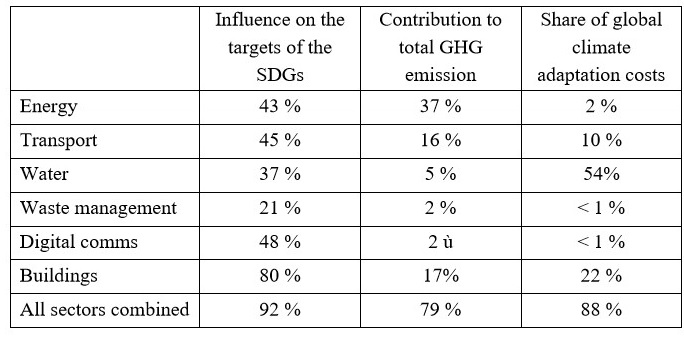
Infrastructure plays a key role in supporting the achievement of the SDGs and the Paris Agreement since it delivers essential services including energy, water, communications, healthcare and education. At the same time, infrastructure is also part of the problem since it a major source of GHG emissions and will be responsible for the biggest part of adaptation cost as illustrated in the table below (source: UNOPS 2021 report “infrastructure for climate action”)

Infrastructure and climate change
Continue reading “Rethinking infrastructure for the future”

Benchmarking on the EU countries’ needs for investments in water infrastructure

The Drinking water Directive 98/83/EC (more) and the Urban Waste Water Treatment Directive 91/271/EEC (more) lay down basic services requirements to be meet by the water operators across the European Union. Both were adopted in the nineties and will have to be updated in order to adapt to recent scientific evidences and new managerial approach.

The issue is not only technical but also political and financial since these two directives entail huge needs for investment in infrastructure water. Despite all the money made available by the EU regional funds for the Member states that joined after 2000, access to finance is often put forward to explain the distance to compliance or to raise concern about the capacity to comply with future regulations on water supply and sanitation.

Continue reading “Benchmarking on the EU countries’ needs for investments in water infrastructure”