Today, 55% of the world’s population lives in urban areas, a proportion that is expected to increase to 68% by 2050. Projections show that urbanization – the gradual shift in residence of the human population from rural to urban areas, combined with the overall growth of the world’s population – could add another 2.5 billion people to urban areas by 2050, with close to 90% of this increase taking place in Asia and Africa.
Water forms the foundation of all natural systems. Its unique physical properties make it irreplaceable for energy transfer and ecosystem regulation—earning it the designation as “the bloodstream of the biosphere.” Beyond its ecological role, water is essential for human health and economic prosperity.
To secure reliable access to this vital resource, humanity has developed infrastructure with three core functions: storage, transport, and treatment. Water infrastructure is characteristically capital-intensive and long-lived, with high upfront costs that cannot be easily recovered if projects fail. In Europe, the Water Framework Directive 2000/60/EC makes a distinction between services and uses.
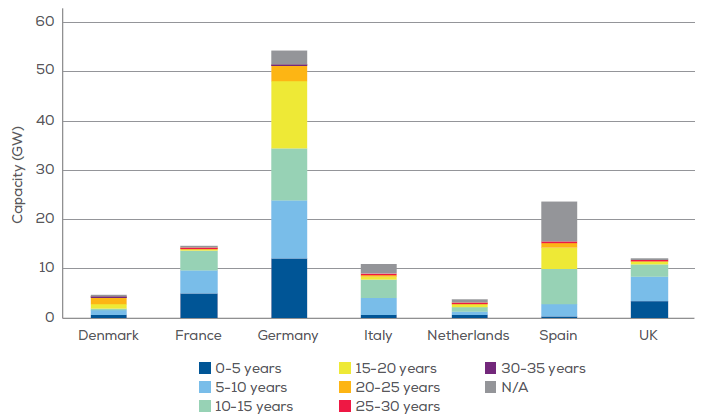
Today, the first generation of wind turbines is nearing the end of its operational life. This is a major challenge for the wind industry. On the one hand, the repowering of existing wind farms (often in the best locations) is becoming a major issue. According to Wind Europe (link), it can double the generating capacity (in MW) of a wind farm and triple the electricity output because the new turbines produce more power per unit of capacity. This is achieved by reducing the number of turbines by an average of 27%. However, operators have faced significant difficulties and delays in renewing their permits. Less than 10% of the wind turbines that will reach the end of their life in 2023 will be repowered. Many have just received a permit extension. On the other hand, the wind industry claims to be 100% circular. If composites can achieve an optimal balance of high strength-to-weight ratio, mechanical properties, design flexibility and durability, recycling these materials is a challenge whose magnitude is only beginning to be understood. According to Wind Europe, the total amount of decommissioned blade material in Europe will increase from less than 100,000 tons in 2020 to 350,000 tons in 2030. The chart below (source: Wind Europe paper) shows the age of Europe’s onshore wind fleet

 Sustainable Synergies