Can shipment restrictions boost EU plastic waste recycling capacity?

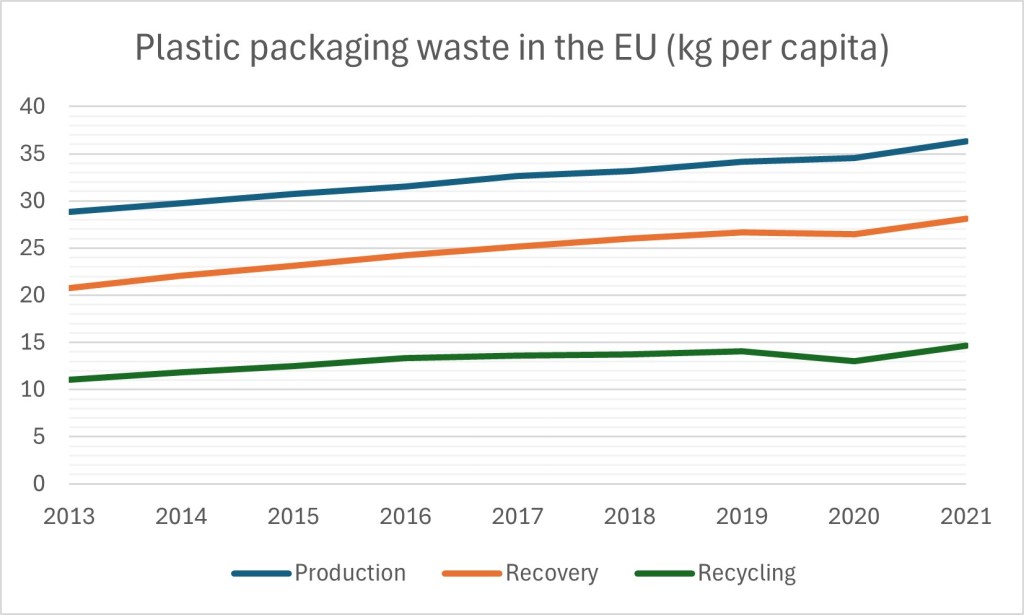
The total plastic packaging waste produced in the EU in 2021 was 16,13 million tons. It is equivalent to 36.1 kilos per capita et per  year  (29% increase between 2010 and 2021). In 2021, 6,56 million tons of plastic waste were recycled in the EU. Even if the recycling capacity in the EU has increased, it is not enough to compensate the increase of packaging plastic wastes as illustated by the chart below.

Continue reading “Can shipment restrictions boost EU plastic waste recycling capacity?”

Issues currently at stake with the adoption of UN treaty on plastic pollution

In March 2022, the United Nations Environment Assembly adopted a resolution for the development of an “international legally binding instrument on plastic pollution, including in the marine environment“. The resolution calls for attention to product design, environmentally sound waste management, efficient use of resources and circular economy approaches. According to its mandate, this process is expected to deliver a proposal for a global treaty at the fifth Intergovernmental Negotiating Committing (INC-5) in Busan, Republic of Korea, from 25 November to 1 December 2024.
INC-4 took place in Ottawa from 23 to 29 April with 2,500 delegates participating in 5 working groups. As Systemiq put it in a briefing note for negotiators (link), the discussions can be grouped around 2 key variables: the scope of the treaty and the need for coordination.

Continue reading “Issues currently at stake with the adoption of UN treaty on plastic pollution”

How much can waste-to-fuel pyrolysis help to solve the plastic crisis?

The global production of plastic has increased, from 1.5 million tons in 1950 to approximately 359 million tons in 2018. Approximately 4% of crude oil production is directly utilized in plastic production. Plastic materials (usually packaging) are the third largest contributor of municipal solid waste (about 12 %). The continuous disposal of plastic wastes is destructive to both terrestrial and marine ecosystem, as they are not readily biodegraded and can take several years to vanish.

Continue reading “How much can waste-to-fuel pyrolysis help to solve the plastic crisis?”

Can plastic recycling be boosted through a global regulatory framework?

Plastic is a recent material (industrial production started at the beginning of the 20th century) that is relatively cheap and combines a set of valuable properties (lightness, strength, durability). These can be further extended with different additives. Since 1950, annual global plastic production has increased from 2 to 380 million tons and is projected to double by 2035 and almost quadruple by 2050. As a matter of fact, modern life is unthinkable without it. The chart below presents the global plastic use by polymer and sector (source: OECD policy paper Improving Plastics Management: Trends, policy responses, and the role of international co-operation and trade).

Continue reading “Can plastic recycling be boosted through a global regulatory framework?”