Wind Turbine Blade Recycling: A Driving Force to Circularize the Composites Value Chain?

Today, the first generation of wind turbines is nearing the end of its operational life. This is a major challenge for the wind industry. On the one hand, the repowering of existing wind farms (often in the best locations) is becoming a major issue. According to Wind Europe (link), it can double the generating capacity (in MW) of a wind farm and triple the electricity output because the new turbines produce more power per unit of capacity. This is achieved by reducing the number of turbines by an average of 27%. However, operators have faced significant difficulties and delays in renewing their permits. Less than 10% of the wind turbines that will reach the end of their life in 2023 will be repowered. Many have just received a permit extension. On the other hand, the wind industry claims to be 100% circular. If composites can achieve an optimal balance of high strength-to-weight ratio, mechanical properties, design flexibility and durability, recycling these materials is a challenge whose magnitude is only beginning to be understood. According to Wind Europe, the total amount of decommissioned blade material in Europe will increase from less than 100,000 tons in 2020 to 350,000 tons in 2030. The chart below (source: Wind Europe paper) shows the age of Europe’s onshore wind fleet
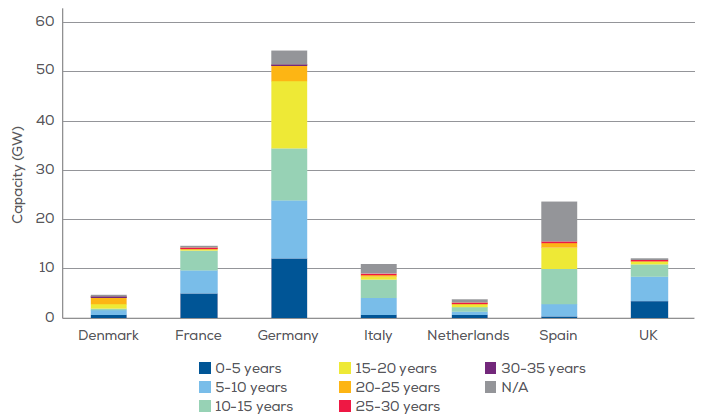
Age of Europe's onshore wind fleet (source: Wind Europe)

Continue reading “Wind Turbine Blade Recycling: A Driving Force to Circularize the Composites Value Chain?”

Territorializing circularity as a key success factor for engaging the transition

The territorial dimension in CE debates receives little attention compared to the technological and economic discussion on the topic. One explanation could be that the concept of circular economy comes from the fields of industrial ecology, business and product design, which include the study of “people”, such as management and business models for circular enterprises, and “flows”, such as secondary materials and reuse methods for circular production.

Another explanation could be related to the difficulty of defining a territory. While “local” refers to a specific geographic scale, “territory” encompasses a physically delimited and socially organized space. Territories are not simply physical spaces, but are shaped by specific organizational structures and are the result of social constructs. They represent the collective effort of a group of actors working towards a common project, with its own rules of governance and cultural heritage. They may not conform to administrative boundaries.

Continue reading “Territorializing circularity as a key success factor for engaging the transition”

Rethinking infrastructure for the future

The Paris Agreement and the 2030 Agenda for Sustainable Development were both adopted in 2015. As illustrated by the Connect4Climate infographic, the implementation timing of the instruments is closely related and there are a lot of synergies between nationally determined contributions to achieve carbon neutrality in 2050 under the Paris Agreement and 17 UN Sustainable Development Goals to be reached by 2030.

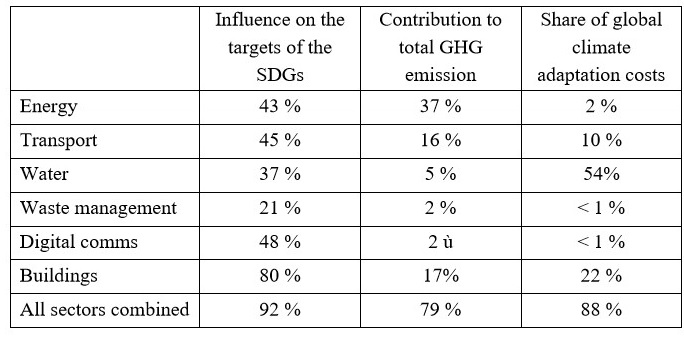
Infrastructure plays a key role in supporting the achievement of the SDGs and the Paris Agreement since it delivers essential services including energy, water, communications, healthcare and education. At the same time, infrastructure is also part of the problem since it a major source of GHG emissions and will be responsible for the biggest part of adaptation cost as illustrated in the table below (source: UNOPS 2021 report “infrastructure for climate action”)

Infrastructure and climate change
Continue reading “Rethinking infrastructure for the future”

Municipal waste collection issues at stake under the proposed revision of the Waste Framework Directive

‘Collection’ is defined by Waste Framework Directive 2008/98/EC as amended by 2018/851/EC as: ‘the gathering of waste, including the preliminary sorting and preliminary storage of waste for the purposes of transport to a waste treatment facility.’ This is the point where begin any waste management processes which are imposed by law. One of them is the obligation to organize separate collection system for the flowing waste streams:

  • paper, metal, plastic and glass (2015)
  • bio waste (31 December 2023)
  • textile and hazardous household waste (1 January 2025).
Continue reading “Municipal waste collection issues at stake under the proposed revision of the Waste Framework Directive”

How can composting systems improve municipal solid waste management in developing countries ?

Composting is a growing global concern for cities who face increasing waste generation and the associated climate impact, especially in developing countries where, even if consumption habits are changing, organic matters still represent more than 50 % of the domestic solid wastes. Here are the usually expected benefits from compositing municipal organic waste in cities.

  • Public hygiene in the suburbs: the organic matters contribute to diseases spreading and cause a significant loss of amenity (odors, rodent, etc) in the public space if they are not regularly collected (especially in hot and wet conditions)
  • Municipal solid waste management system: composting can cut the quantities of waste to be landfilled and the environmental impacts associated with it (gas emissions, odors, leachate). It requires less investment and operational capacity that anaerobic digestion. Indirectly, separating the organic matters from other waste will make the sorting of other recyclables much easier and more efficient.
  • Agricultural production system: as soil conditioner and “slow” fertilizer, compost has a real potential to reduce the needs for chemicals and contribute to soil conservation (and thus to restore soil fertility on the long term). Typically, one kilogram of compost per square meter is distributed annually to farmlands.
  • Carbon emission: Composting is a carbon neutral natural degradation process, which helps storing carbon in soil. By diverting organic matters from landfills, it decreases methane emissions in proportion. Therefore, composting systems are eligible for carbon credit, but this seems rather difficult. in 2012, only 46 projects were receiving, under the Clean Development Mechanism.
Continue reading “How can composting systems improve municipal solid waste management in developing countries ?”

Enablers to leverage for Circular Economy in Africa

Circular Economy is fast gaining traction as new model for sustainable growth. However, CE continues to be understood primarily as a waste management and recycling strategy, but the economic opportunities are far broader and more diverse. As outlined in the Chatham House research paper “An inclusive Circular Economy: priorities for developing countries” (link), the goal is to promote a broad range of activities and functions geared at:

  • Creating loops: when a product reaches the end of its designed operational life, it is reused, repaired or recycled rather than thrown away.
  • Slowing flows: shifting to new ways of designing and making products ensures that they remain in use for as long as possible, thereby decreasing demand for new products
  • Narrowing flows: this involves shifting to more efficient ways of using products, e.g. sharing products or adopting product-as-a-service models.
Continue reading “Enablers to leverage for Circular Economy in Africa”

Facing the upsurge of municipal wastes in the next decades

The World Bank publication “More growth, less garbage”, estimates waste generation to grow from 2.24 billion tonnes in 2020 to 3.88 billion tonnes by 2050 under a business-as usual scenarios. It will then stand at 1.09 kg of waste per capita per day, on average. This 70 % increase will not be only driven by demographic growth (world population is expected to reach 9.7 billion in 2050, meaning 25 % increase as compared with 2021) but also by increases in prosperity and urbanization in the developing countries where waste generation is expected to triple. There is indeed a strong positive correlation between waste generation per capita and GDP per capita. Here is some projections from the World Bank on the total waste generation by region.

Continue reading “Facing the upsurge of municipal wastes in the next decades”

How much can waste-to-fuel pyrolysis help to solve the plastic crisis?

The global production of plastic has increased, from 1.5 million tons in 1950 to approximately 359 million tons in 2018. Approximately 4% of crude oil production is directly utilized in plastic production. Plastic materials (usually packaging) are the third largest contributor of municipal solid waste (about 12 %). The continuous disposal of plastic wastes is destructive to both terrestrial and marine ecosystem, as they are not readily biodegraded and can take several years to vanish.

Continue reading “How much can waste-to-fuel pyrolysis help to solve the plastic crisis?”

Can plastic recycling be boosted through a global regulatory framework?

Plastic is a recent material (industrial production started at the beginning of the 20th century) that is relatively cheap and combines a set of valuable properties (lightness, strength, durability). These can be further extended with different additives. Since 1950, annual global plastic production has increased from 2 to 380 million tons and is projected to double by 2035 and almost quadruple by 2050. As a matter of fact, modern life is unthinkable without it. The chart below presents the global plastic use by polymer and sector (source: OECD policy paper Improving Plastics Management: Trends, policy responses, and the role of international co-operation and trade).

Continue reading “Can plastic recycling be boosted through a global regulatory framework?”

Europe’s environment is at a tipping point

These were the words of Hans Bruyninckx, EEA Executive Director, when presented Europe’s state of the environment 2020 (link). He put strong emphasis on the conclusion that “Europe has a narrow window of opportunity in the next decade to scale up measures to protect nature, lessen the impacts of climate change and radically reduce our consumption of natural resources”.

Continue reading “Europe’s environment is at a tipping point”