
The Paris Agreement and the 2030 Agenda for Sustainable Development were both adopted in 2015. As illustrated by the Connect4Climate infographic, the implementation timing of the instruments is closely related and there are a lot of synergies between nationally determined contributions to achieve carbon neutrality in 2050 under the Paris Agreement and 17 UN Sustainable Development Goals to be reached by 2030.
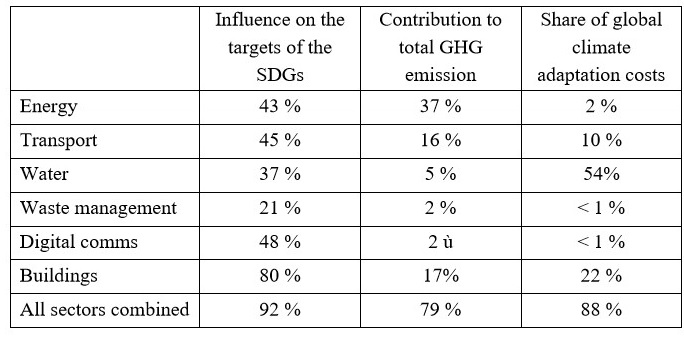
Infrastructure plays a key role in supporting the achievement of the SDGs and the Paris Agreement since it delivers essential services including energy, water, communications, healthcare and education. At the same time, infrastructure is also part of the problem since it a major source of GHG emissions and will be responsible for the biggest part of adaptation cost as illustrated in the table below (source: UNOPS 2021 report “infrastructure for climate action”)
Achieving the Sustainable Development Goals by 2030 and net zero emissions by 2050 require a twofold approach:
- Scaling-up investment in and construction of sustainable infrastructure, particularly in developing countries. In Africa, around 62 per cent of the urban population resides in areas without minimum standards of essential services – including power, water and sanitation – and experiences disproportionate vulnerability to environmental risks.
- Changing radically the way how decisions on infrastructure are made. We must move past the traditional perspectives of infrastructure as simply built assets and evolve towards a perspective of infrastructure as integrated systems. This must be guided by a deep understanding of the synergies and trade-offs between sectoral actions so that negative side effects can be minimized, while opportunities to create positive and wider sustainable development benefits can be enhanced. Attention must also be given to climate-related shocks and stressors as they can undermine the stability of infrastructure systems and their ability to operate.
This approach must also consider other key features of infrastructure:
- Long life span: if new infrastructure is not well-designed or suited to purpose, which can lock in unsustainable practices for decades to come.
- Heavy investment needs. According to the Global Infrastructure Hub, infrastructure sector investment needs by sector over the period 2016-2040
- Energy: $ 28.0 Trillion
- Transport: $ 49.9 trillion
- Water: $ 6.4 trillion
- Digital communications: $ 8.9 Trillion
- Quality, reliability and affordability of the services
The International Good Practice Principles for Sustainable Infrastructure published in 2022 by UNEP calls for the adoption of integrated, systems-level approaches to sustainable infrastructure planning, delivery, and management. In this case, infrastructure systems comprise physical assets (also referred to as hard infrastructure) plus the knowledge, institutions, and policy frameworks (also referred to as soft infrastructure) in which they exist and that enable them to function. These ten principles are aimed at supporting governments’ decision over the whole infrastructure life cycle.
- Strategic planning to ensure the alignment of infrastructure policies and decisions with global sustainable development agendas and to strengthen the enabling environment.
- Responsive, resilient, and flexible service provision to meet actual infrastructure needs, allow for changes and uncertainties over time, and promote synergies between infrastructure projects and systems.
- Comprehensive Life Cycle Assessment of sustainability, including the cumulative impacts of multiple infrastructure systems on ecosystems and communities over their entire lifespans, to avoid “locking in” infrastructure projects and systems with various adverse effects.
- Avoiding environmental impacts of infrastructure systems and investing in natural infrastructure to make use of nature’s ability to provide essential, cost-effective infrastructure services and provide multiple co-benefits for people and the planet.
- Resource efficiency and circularity to minimize infrastructure’s natural resource footprint, reduce emissions, waste and other pollutants, and increase the efficiency and affordability of services.
- Equity, inclusiveness and empowerment through a balance between social and economic infrastructure investment to respect, protect and fulfil human rights and promote well-being, particularly of more vulnerable or marginalized groups.
- Enhancing economic benefits through employment generation and support for the local economy.
- Fiscal sustainability and innovative financing to close the infrastructure investment gap within the context of increasingly constrained public budgets.
- Transparent, inclusive and participatory decision making that includes stakeholder analysis, ongoing public participation, and grievance mechanisms for all stakeholders.
- Evidence-based decision-making that includes regular monitoring of infrastructure performance and impacts based on key performance indicators and the promotion of data sharing with all stakeholders
The “scaling-up essential services in African cities” report released in 2022 by the African Development Bank, UNOPS and Cities Alliance points some leverage points to elaborate transformative strategy:
- Nature-based solutions are key in providing protection from environmental risks and supporting climate mitigation and adaptation efforts.
- Digital infrastructure can improve efficiency, transparency and affordability of service delivery and bridge the digital divide to achieve prosperity.
- With circular economy principles, African cities have the opportunity to build next-generation sustainable economies and reshape material and resource use across water, sanitation and waste systems.
- Decentralization of services has the potential to meet service delivery needs in a cost-effective manner using local resources.
- Labor intensive rather than capital- or technology-intensive approaches to the provision of sanitation, renewable energy and community access roads should be adopted to meet the goals of employment generation and green growth in African cities.
- Mainstreaming gender and inclusion-related considerations across the infrastructure life cycle in all sectors can reduce of violence against women and girls and enable equal access to critical services and socio-economic opportunities for all.

 Sustainable Synergies