‘Collection’ is defined by Waste Framework Directive 2008/98/EC as amended by 2018/851/EC as: ‘the gathering of waste, including the preliminary sorting and preliminary storage of waste for the purposes of transport to a waste treatment facility.’ This is the point where begin any waste management processes which are imposed by law. One of them is the obligation to organize separate collection system for the flowing waste streams:
- paper, metal, plastic and glass (2015)
- bio waste (31 December 2023)
- textile and hazardous household waste (1 January 2025).
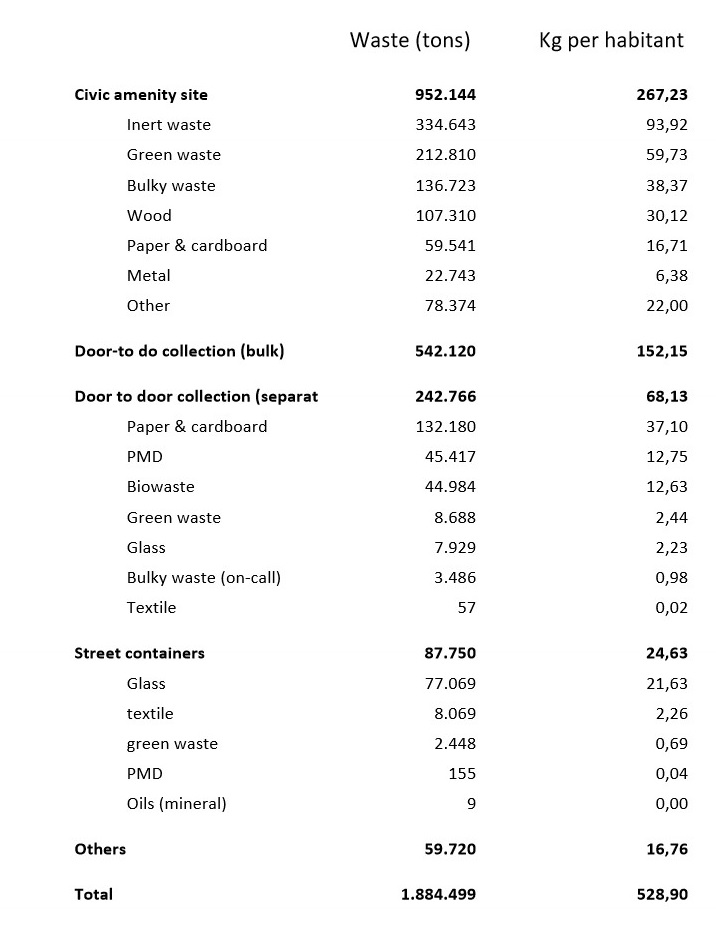
Separate collection is defined by the Directive as “the collection where a waste stream is kept separately by type and nature so as to facilitate a specific treatment”. Different systems exist: door-to-door collection, deposit points (street containers, civic amenity site) or other collection arrangement (on-call service, in-shop take back, collective composting, etc). The territory to be covered by a specific waste collection system is divided in several collection areas that are served by a garbage truck according to a fixed itinerary and schedule. The table below presents an overview of collection systems implemented in Wallonia, Belgium, in 2013 (source: Plan Wallon des Déchets),
In line with the Best Environmental Management Practice for the Waste Management Sector finalized by the JRC in 2018 (link), here is a list of performance indicators for municipal waste collection systems:
- Participation rate (% population having access to the waste collection system)
- Coverage rate (% territory that is covered by the waste collection service)
- % of selectively collected wastes
- Tons of collected wastes per truck use hour
- Tons of collected wastes per km driven by the garbage truck
- Waste collection time / Truck use time ratio
- Sorting quality (% of non-compliance)
As highlighted in the Guidance for separate collection of municipal waste released in 2020 by EC Commission, DG Environment (link), effective municipal waste collection systems rely on 4 pillars:
- Economic instruments that secure funding and / or incentives for waste sorting. These include the extended producer responsibility principle, Pay-as you Throw scheme- PAYT, landfill taxation, deposit refund,
- Legal enforcement: Although communication incentivizes households to behave correctly, a control system is needed to check the sorting quality of collected waste and to curb the uncontrolled and illegal abandoning of waste (the so-called “fly-tipping”)
- Customized facilities according to the type of waste and local context (population density, type of habitat, road access, weather conditions).
- Engaging communication: This is critical to inform and motivate households to sort waste. On the other hand, one should stress the need for consistency between the waste management strategy and the communication messages.
The early warning reports form the EC Commission and the European Environment Agency on the progress towards has showed that, over half of Member States are at risk of not reaching the 2025 preparation for re-use and recycling targets for municipal waste. Low recycling rates, as well as lower quality recyclates, are in part due to inefficient waste-collection systems. The goal is to improve separate waste collection to yield optimal recycling results, including by avoiding contamination of recyclable waste,. In the meantime, the Commission has recognized that the organization of the collection is highly context-dependent and has refrained from imposing uniform measures. This point will be included in the ongoing consultation that the EC Commission has launched until 16 august 2022 on the needs to revise the Waste Framework Directive (link).
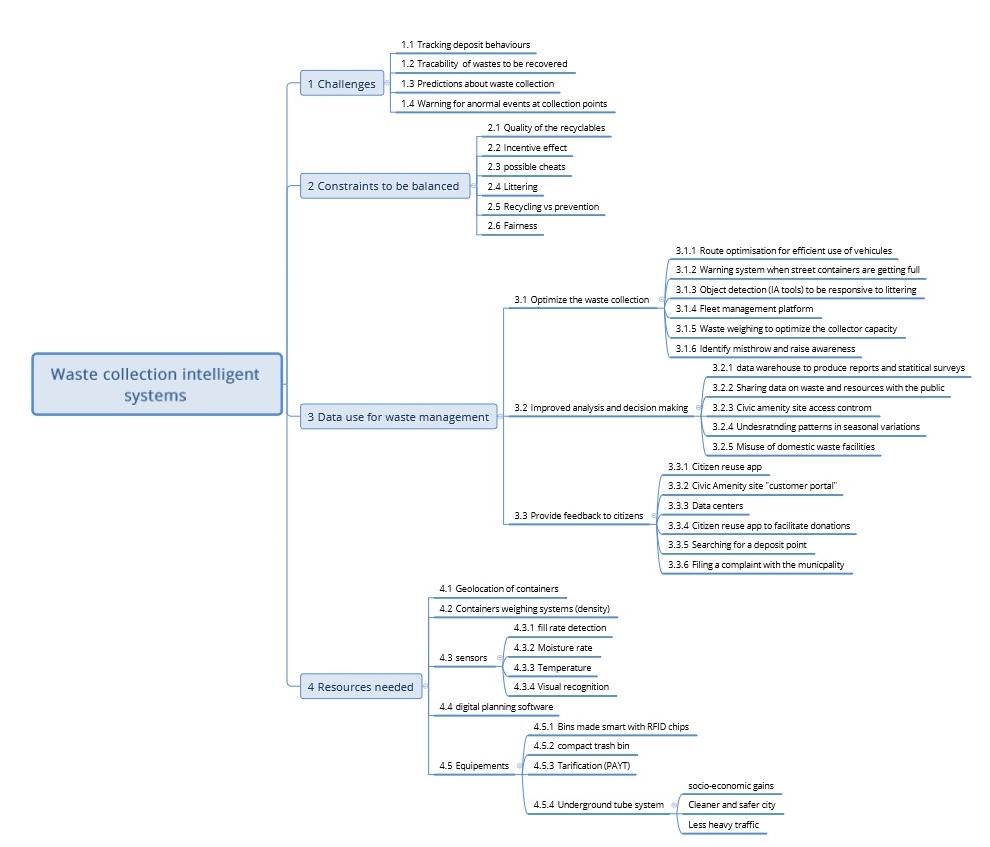
In this context, one can wonder how geo-positioning and IT tools can help to improve municipal waste management at local level. This was the central topic of the WINPOL project funded by the INTERREG program over the period 2018-2022 with eight public waste operators across Europe. A good practices guide (link) presents a large panel of solutions with interesting details (description of the practice, resources needed, evidence of success, implementation costs, challenges to overcome, potential for transfer, website) The mind map below is an attempt to wrap up the content of this guide.

 Sustainable Synergies