Circular Economy is fast gaining traction as new model for sustainable growth. However, CE continues to be understood primarily as a waste management and recycling strategy, but the economic opportunities are far broader and more diverse. As outlined in the Chatham House research paper “An inclusive Circular Economy: priorities for developing countries” (link), the goal is to promote a broad range of activities and functions geared at:
- Creating loops: when a product reaches the end of its designed operational life, it is reused, repaired or recycled rather than thrown away.
- Slowing flows: shifting to new ways of designing and making products ensures that they remain in use for as long as possible, thereby decreasing demand for new products
- Narrowing flows: this involves shifting to more efficient ways of using products, e.g. sharing products or adopting product-as-a-service models.
In order to spur Africa’s transition, a coalition of African nations has created the African Circular Economy Alliance (ACEA) which has released in April 2021 a research study (link) aimed at prioritizing circular opportunities in Africa. It led to the identification of 5 major sectors: food systems, packaging, the built environment, electronics and fashion & textiles. This was based on the criteria listed in the table below:

There is a growing consensus on a set of enablers at national level for implementing CE in Africa:
- Need for a strategic vision to engage the transition. CE policymaking is also likely to demand a level of centralized or distributed coordination across multiple ministries that is often difficult to achieve in developing countries. Environment Ministries are often amongst the weakest deaprtments in governement with limited influence over the industrial and innovation strategies needed to succeed in a CE.
- Supportive product policies (ban on single use items, extended producer responsibility, standards). There is a risk that developing countries will install cheaper but limited-quality technologies and equipment, including those mis-sold under the guise of a CE.: Enforcement may prove to be challenging due to informality of most operators and the prominent role of innovative products that regulators may not know about.
- Access for SMEs to financial and advisory services, which may prove to be a challenge given the emerging nature of CE solutions and the informality of many operators.
- Access to data to inform policy-making and investment opportunities. Very few other developing countries are included in existing macroeconomic models of the effects of shifting to a CE. The scarcity of collated information and effective practices regarding relevant CE opportunities on the continent is partly driven by the limited CE academic focus on the continent
- Waste infrastructure is conducive for circularity. These installations are often expensive and innovative financing models are required. A reverse logistic system is needed to scale up the reuse of materials and products is inadequate. Great care should be given to avoid illegal importation of waste
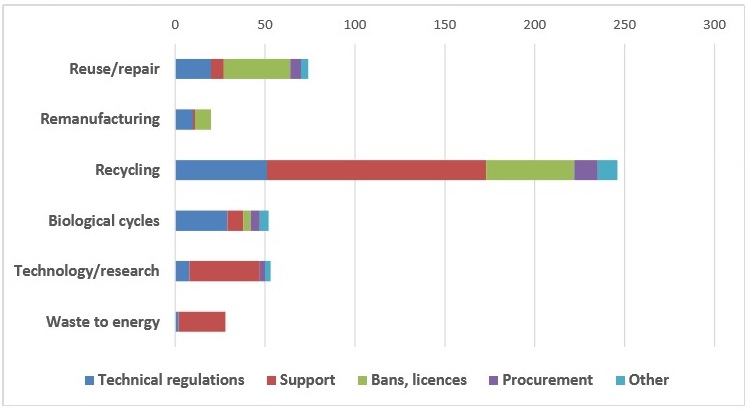
Moreover, a collaborative agenda at the global level that aligns the CE with existing policy priorities around sustainable development and trade cooperation is needed to accelerate the development of circular value chains both in developed and developing countries. Common rules and standards for international circular value chains must be agreed at global level, particularly where they risk displacing traditional workers or are associated with environmental or health risks, as is the case with e-waste. As a matter of illustration, the chart below presents an analysis of the measures notified to the WTO which refer to activities related to the circular economy between 2009 and 2017 (source: Trade policies for a circular economy: learning from WTO experience)
In the meantime, significant progress has been made on the technological foundations for CE activity. A growing range of data and information technologies are making CE solutions practical for the first time in a range of sectors. The Ellen MacArthur Foundation and Google, with research and analytical support provided by McKinsey & Company has published in 2021 a research paper (link) that highlights the role of artificial intelligence as an accelerator of the transition. For instance, the potential value unlocked by AI in helping design out waste in a circular economy for food is up to $127 billion a year in 2030. This is realized through opportunities at the farming, processing, logistics, and consumption stages. Specific applications include: using image recognition to determine when fruit is ready to pick; matching food supply and demand more effectively; and enhancing the valorization of food by-products. In many developing countries, however, the ‘digital divide’ remains a very serious problem,

 Sustainable Synergies