The World Bank publication “More growth, less garbage”, estimates waste generation to grow from 2.24 billion tonnes in 2020 to 3.88 billion tonnes by 2050 under a business-as usual scenarios. It will then stand at 1.09 kg of waste per capita per day, on average. This 70 % increase will not be only driven by demographic growth (world population is expected to reach 9.7 billion in 2050, meaning 25 % increase as compared with 2021) but also by increases in prosperity and urbanization in the developing countries where waste generation is expected to triple. There is indeed a strong positive correlation between waste generation per capita and GDP per capita. Here is some projections from the World Bank on the total waste generation by region.

Considering that, today, 3 billion people do not have access to controlled waste disposal facilities (source UN Habitat), coping with such an upsurge is a pressing challenge for cities in Africa and Asia. In addition to severe impacts on the environment and public health, this situation results in the generation of 3 – 5 % of anthropogenic greenhouse gas emission (global GHG emissions amounted to 45.87 bn tons CO2 equivalent in 2018 according to the World Bank). It is mostly due to methane emission from open dump site which is a very common practice in developing countries. One should also stress the potential for further reduction of GHG emissions in this sector when waste actions beyond disposal are implemented (collection & transportation, recycling, energy recovery, waste minimization), The Eunomia study “Waste in the Net-Zero Century” has calculated it up to 2.76 bn tonnes CO2 equivalent per year.
The International Solid Waste association (ISWA) has recently released a vision document “The Future of the Waste Management Sector” that takes stock on the trends, opportunities, and challenges for the next decade. It suggests 2 paths of development:
- Priority should be given to extend the provision of basic waste services globally. Additional efforts are deadly needed to implement the integrated waste management framework and guiding principles (waste hierarchy, polluters-pays, etc). Special attention should be given to funding in developing countries as municipal waste management may represent up to 15 percent of the municipal budgets of which 80 percent to 90 percent is spent on waste collection, constraining their ability to address the subsequent steps.
- The transition to circular economy should be accelerated. It is imperative for the waste management sector to shoulder the responsibility of the recovered resource and material provider of the circular economy and partner up with other actors along the value chain work persistent and proactively to promote waste prevention, reduction and reuse.
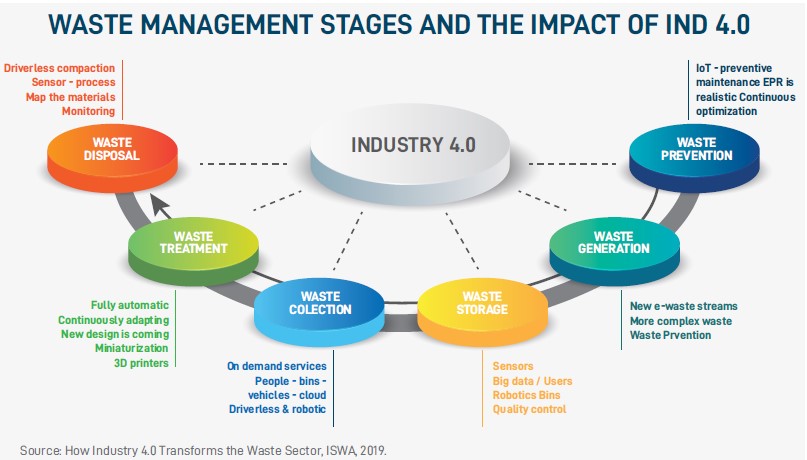
Finally, ISWA made an interesting point about advances in technologies which are likely to become mainstream and profoundly change the waste industry. This is illustrated by the chart below:

 Sustainable Synergies