The Waste Framework Directive 2008/98/EC sets a target of 50 % of municipal waste to be recycled and prepared for reuse by 2020 in EU Member States, for at least four categories (i.e. paper, glass, metals, plastics) of waste. To this end, the EU budget strongly supported Members via Cohesion funds, Horizon 2020, LIFE, etc ( a total of EUR 4.9 billion was allocated by 17 EU Member States for the 2014-2020 period). EEA figure on the share of treatment methods of municipal wastes shows that very significant progress has been achieved over the 2004-2016 period .

However, there are large differences between member states as illustrated by the EEA figure on municipal waste recycling rate (including composting and digestion) by country. In 2018, the European Commission and the European Environmental Agency indicated that 14 EU Member States are at risk of not meeting the 2020 target

In 2013 the 7th Environment Action Program stated that, by 2020, waste should be safely managed as a resource, landfilling would be limited to residual and energy recovery would be limited to non-recyclable materials. This perfectly feeds into the waste hierarchy. Accordingly, the Waste Framework 2008/98/EC, the Landfill Directive 1999/31/EC and the Packaging and Packaging Waste Directive 94/62/EC were amended to include, inter alia, a number of new targets and measures beyond 2020:
- targets to increase preparing for reuse and recycling of municipal waste to at least 55 % of municipal waste by 2025, 60 % by 2030 and 65 % by 2035;
- targets to increase recycling of packaging waste to at least 65 % by 31 December 2025 and 70 % by 31 December 2030;
- a target to reduce landfill to a maximum of 10 % of generated municipal waste by 2035;
- a ban on landfilling of waste suitable for recycling effective from 2030;
- mandatory separate collection of bio-waste by 31 December 2023 and of textiles and hazardous waste from households by 1st of January 2025;
- minimum requirements for all extended producer responsibility schemes;
- simplified and improved definitions and harmonised calculation methods for recycling rates throughout the EU.
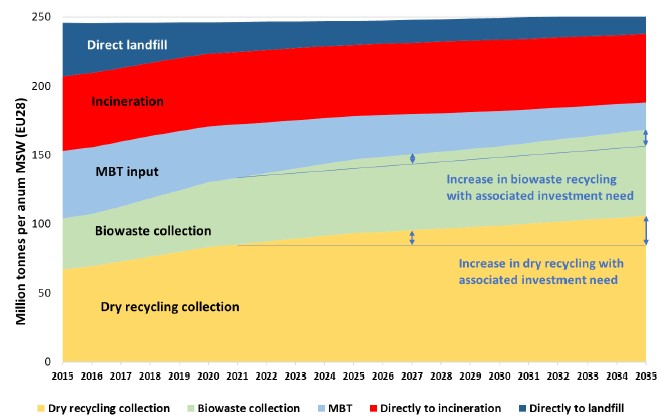
Obviously such a level of ambition will require major structural changes for waste management, including organization, delivery and investments (improved collection systems, biowaste treatment facilities, materials sorting and materials recycling /reprocessing infrastructure). The figure below presents a view how those changes are likely to translate to a need for new investments over the 2021–2035 period accord to the study on investment needs in the waste sector and on the financing of municipal waste management in Member States that was published in 2019 by the EC Commission.
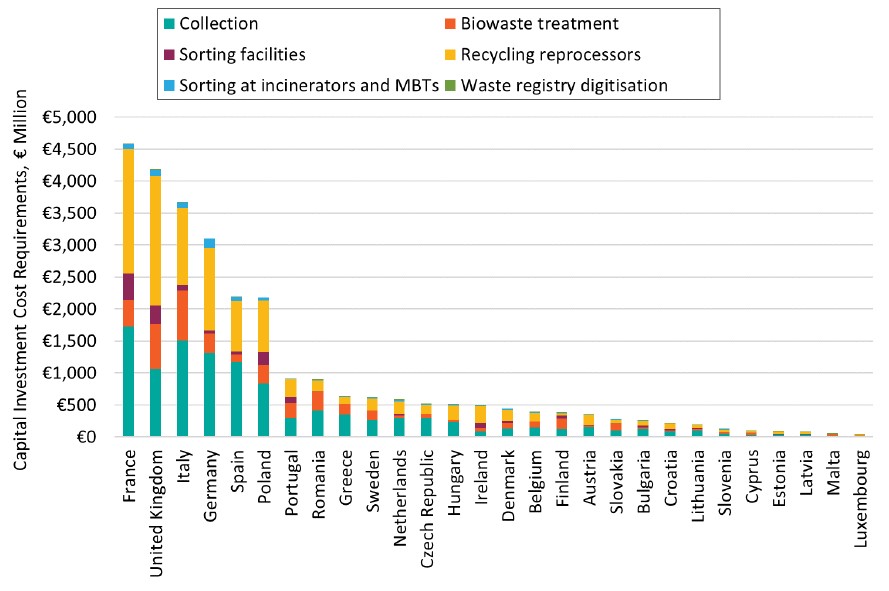
Based on detailed calculations and some assumption (i.e. the waste is treated in the EU) , the study has elaborated projections about capital cost investments needs for the period 2021-2035
Finally, one should stress that all these efforts should not preempt the attention given to treat properly the residual waste since not every waste can be recycled. As stated by the European Federation for Waste Management and Environmental Services in its position paper on regulatory framework for sustainable investment, we must rely on an integrated waste management approach with an appropriate and sustainable interaction of quality recycling, efficient energy recovery and environmentally sound disposal of waste that cannot be recovered.

 Sustainable Synergies