
The Drinking water Directive 98/83/EC (more) and the Urban Waste Water Treatment Directive 91/271/EEC (more) lay down basic services requirements to be meet by the water operators across the European Union. Both were adopted in the nineties and will have to be updated in order to adapt to recent scientific evidences and new managerial approach.
The issue is not only technical but also political and financial since these two directives entail huge needs for investment in infrastructure water. Despite all the money made available by the EU regional funds for the Member states that joined after 2000, access to finance is often put forward to explain the distance to compliance or to raise concern about the capacity to comply with future regulations on water supply and sanitation.
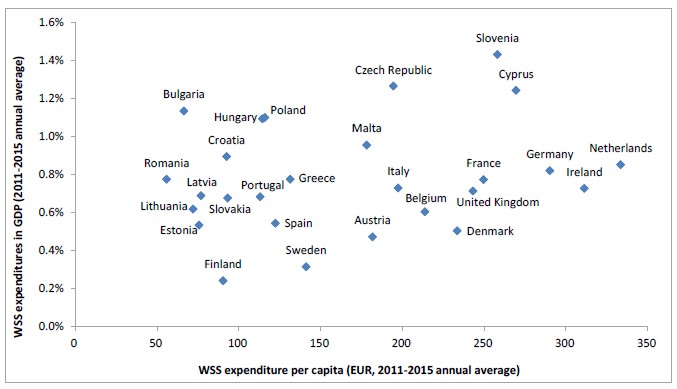
On May 28, 2020, the OECD and the European Commission released a joint study that documents investment needs in member states and takes stock on financing challenges (study). This study contains a set of well-grounded evidences. As a matter of example, the graph below shows the water supply and sanitation expenditures per capita in EU Member states.
The need for investment that is to be financed by 2030 in each country was assessed according to 3 scenarios: (see graph below)
- business as usual for water supply and sanitation services (BAU)
- For water supply: projections to achieve compliance, efficiency (25 % leakage reduction) and access (WS)
- For sanitation: projections to achieve compliance(WW)
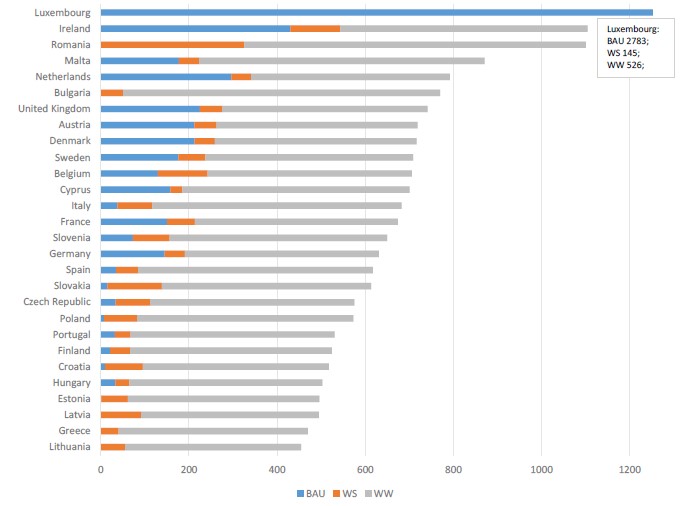
Whatever they are significant differences between member states depending on the drivers (urbanization, drought, etc), all of them will have to raise by at least 25 % the level in investments in water infrastructure. In the case of Romania, it will even go up to 180 %. In any case, one should stress that it does not take into account other needs arising from the implementation of the Water Directive 2000/60/EC aimed at restoring the quality of water bodies to good status.
Based on that, the study has formulated a series of policy recommendations :
| Make the best use of existing assets and financial resources | Minimize future financing needs | Harness additional sources of finance |
| Enhance the operational efficiency of water and sanitation service providers | Manage water demand | Ensure tariffs for water services reflect the costs of service provision |
| Encourage connections, where central assets are available | Strengthen water resource allocation | Consider new sources of finance |
| Develop plans that drive decisions | Encourage policy coherence across water policies and other policy domains (including nature-based solutions) | Leverage public and cohesion funds to crowd-in domestic commercial finance |
| Support plans with realistic financing strategies | Exploit innovation in line with adaptive capacities | |
| Strengthen capacity to use available funds | ||
| Build capacity for economic regulation |
The EU recovery plan published in May 2020 (link) has listed the protection of water resources and waste water treatment among the priorities. This is a great news but it is unclear how this money will be used. Issues like economic regulation and asset management are likely to prompt on the policy agenda at the same time as the technical legislation will be under revision. For sure, this will keep the EC Commission busy for a while.

 Sustainable Synergies